An interactive vocabulary study tool built around contextual learning, morphological awareness, and concept mapping — three of the most research-grounded approaches to vocabulary acquisition. WordMint guides every learner through pronunciation, contextual practice, and word relationships, focusing each session on the words they still need to master.
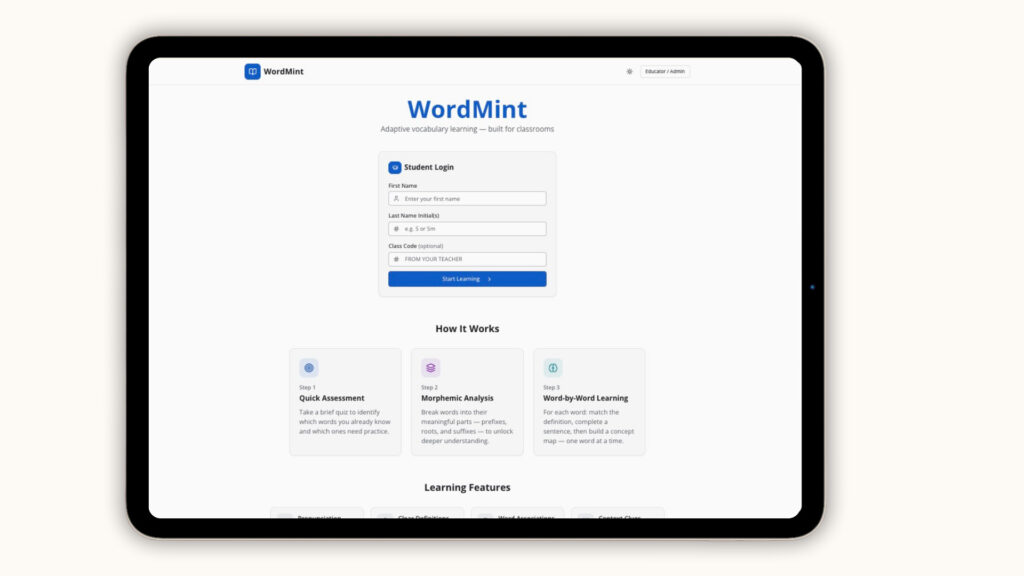
Whole-class vocabulary review wastes the time of learners who already know half the list — and loses the ones who don’t know any of it. WordMint solves this by running a brief diagnostic at the start of each session, identifying which words each learner already understands, and directing their practice exclusively toward the words they have yet to master.
The result is focused, independent vocabulary work that adapts to the individual — without requiring anything extra from the educator.
WordMint
Standalone
The original adaptive vocabulary tool — build your own word lists for any subject, unit, or standard. Upload your content and WordMint handles the rest.
- Works with any subject or standard
- Build custom word lists in the dashboard
- Full educator controls & progress data
WordMint
Life Science
Cells to ecosystems — an interactive study guide aligned to Virginia Life Science Standards (LS). Covers cell structure, photosynthesis, genetics, classification, ecosystems, and more.
- Virginia SOL aligned (LS.2–LS.11)
- Adaptive diagnostic + practice
- No student accounts required
WordMint
[Topic]
This study guide is currently in development. Check back soon for the full description and availability.
- Virginia SOL aligned
- Adaptive diagnostic + practice
- No student accounts required
The Flow
Five Steps.
Zero Wasted Time.
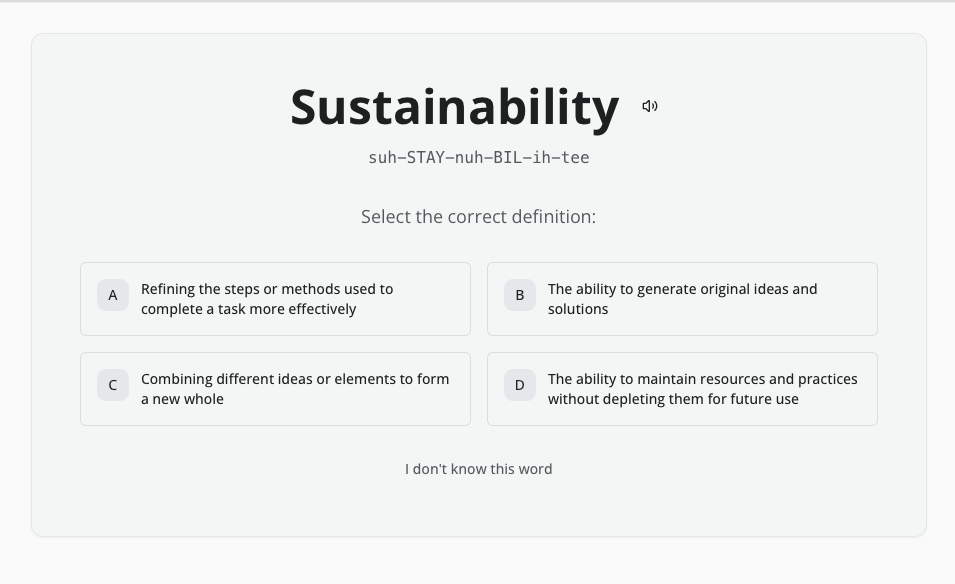
STEP 01
Diagnostic
WordMint opens with a diagnostic that identifies which words the user already knows. Session contains only the words they don’t — no time spent on vocabulary the user already mastered.
STEP 02
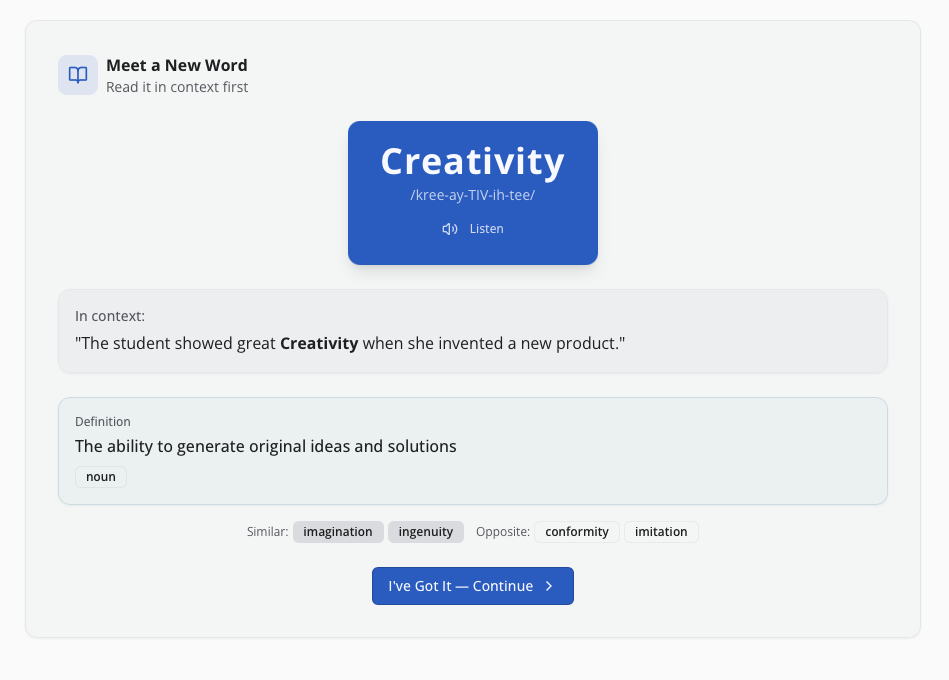
Word in Context
Each new word appears in a real sentence first. Reading a word in context builds the user’s initial understanding before the application introduces a the definition.
STEP 03
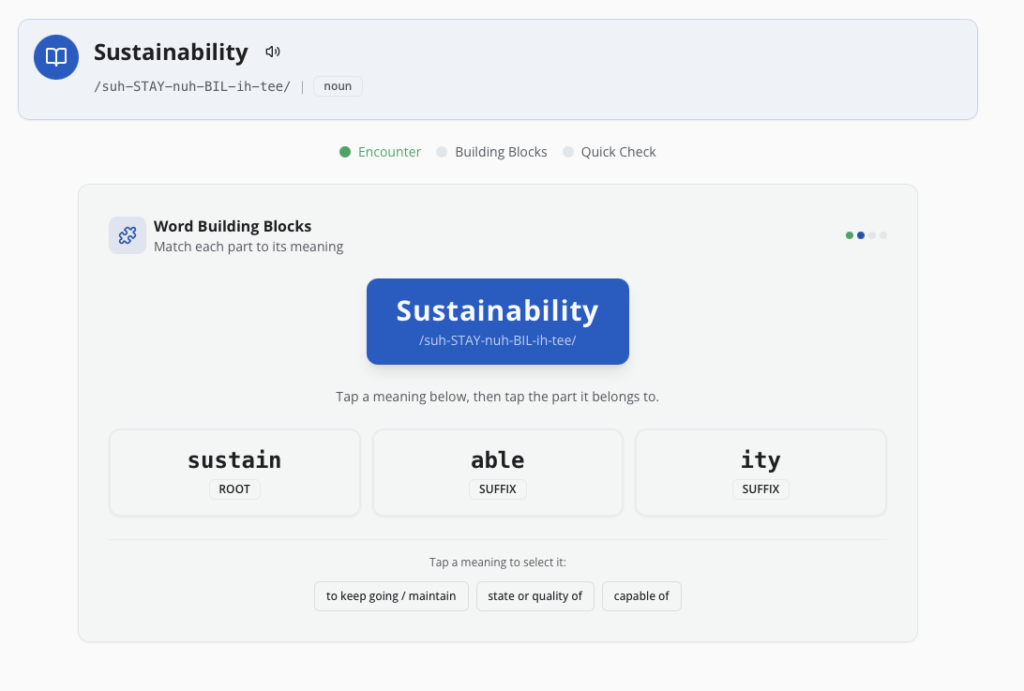
Morphemic Analysis
Match each part of the word — prefix, root, suffix — to its meaning. Morphological awareness built this way transfers to unfamiliar words the user encounters long after the session ends.
STEP 04
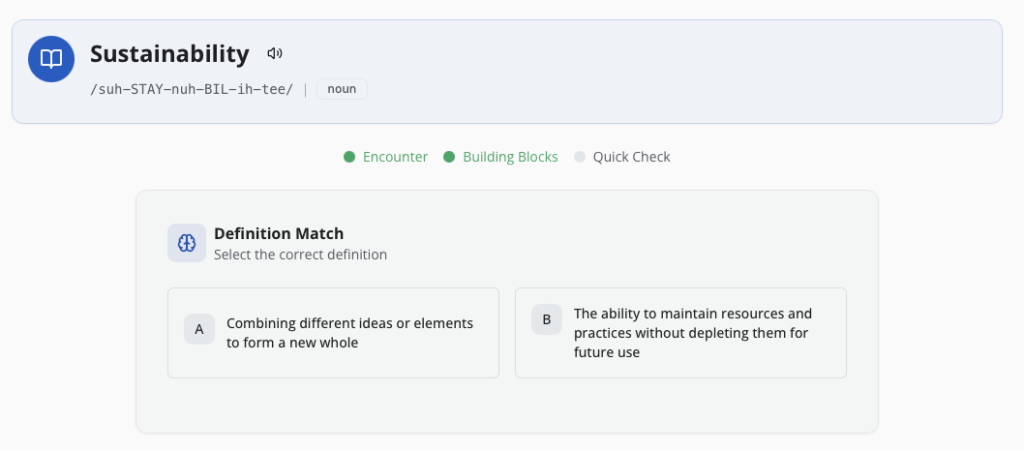
Definition & Fill-in
The user selects the correct definition from carefully constructed options, then complete a fill-in-the-blank sentence. Comprehension first, then application — with an on-demand hint available if the user needs it.
STEP 05
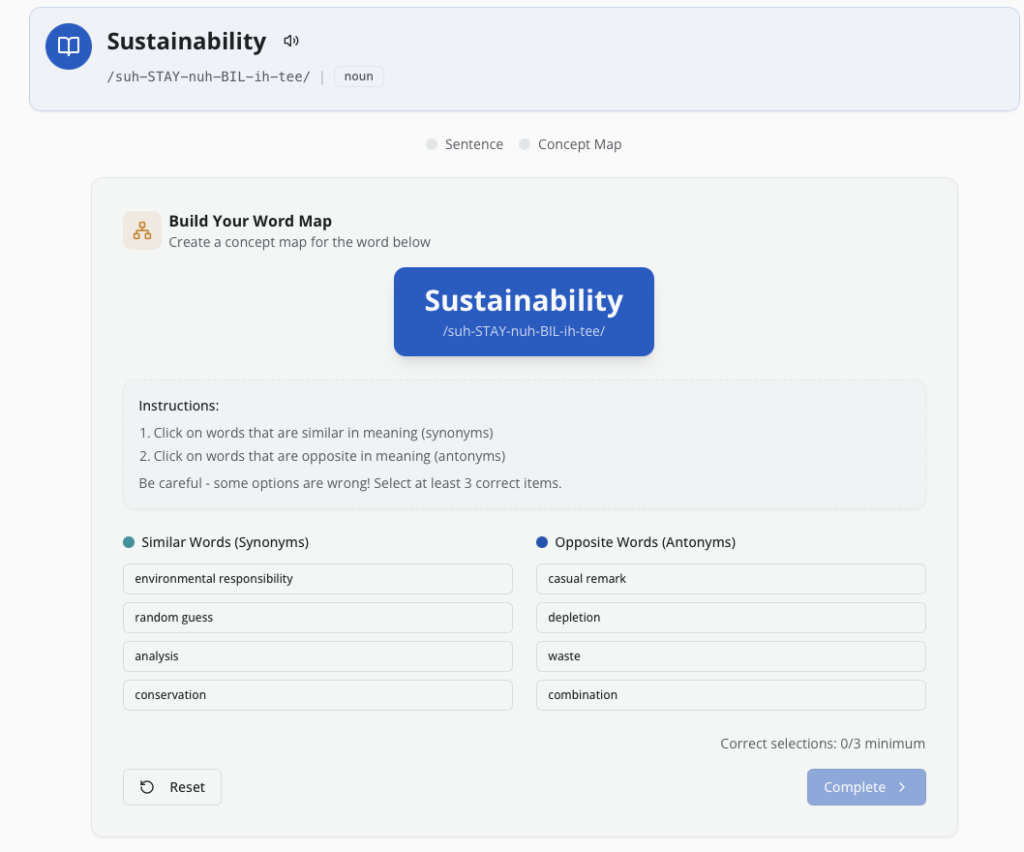
Word Relationships
Sort synonyms and antonyms from a mixed list that includes wrong options. The user must reach a minimum number of correct selections to advance.
WHAT’S INSIDE
Every feature earns
its place.
Audio pronunciation + phonetic respelling
Learners hear each word and see a plain-English pronunciation guide before they are ever asked to use it lowering the barrier to engagement and building spoken confidence alongside written comprehension.
Concept mapping (synonyms and antonyms)
Learners sort true synonyms and antonyms from a mixed list that includes wrong options, and must reach a minimum number of correct selections before advancing. Knowing a word deeply means knowing what it isn’t.
Teacher-authored content
Educators build their own word lists directly in the dashboard or import a ready-made vocabulary pack. WordMint adapts to any subject, unit, reading level, or standard — not a fixed curriculum.
Contextual Fill-in-the-Blank with Constructed Distractors
Fill-in-the-blank items are built with distractors that require genuine comprehension rather than guessing. An on-demand hint provides scaffolding without interrupting independent practice.
Full word profiles
Every word includes a learner-friendly definition, part of speech, example sentence, and morpheme breakdown — prefix, root, and suffix with meanings. Multiple access points into a single word’s meaning, before learners are asked to use it independently.
Tiered and organized word lists
Words are organized by difficulty tier and unit, so intervention learners and advanced learners can work from the same platform at different levels of challenge — no separate setup required.